Human oversight
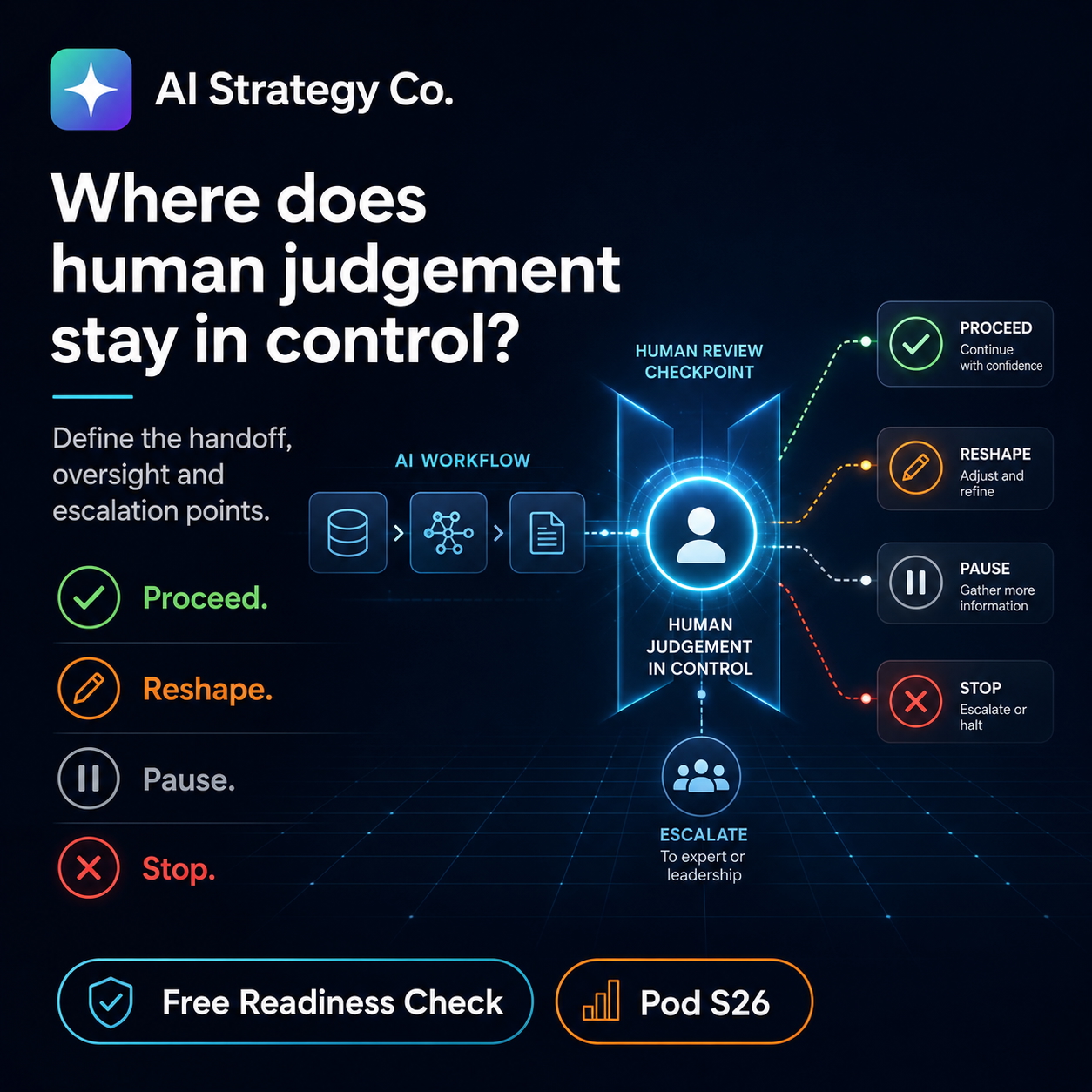
Where does human judgement stay in control?
Define mandatory review, decision rights, escalation and the handoff between the AI-enabled workflow and accountable people.
Bring one government AI pilot, workflow or candidate use case. In a focused 20-minute conversation, AI Strategy Co. will help identify whether it should Proceed, Reshape, Pause or Stop — and what must be resolved before more engineering, procurement or approval effort is committed.
Government AI initiatives often reach technical proof-of-concept while the operating, control and approval path remains unclear.
The project has a sponsor or technical lead, while accountability for the AI-enabled operating outcome remains fragmented.
The pilot lacks precise rules for data access, human review, escalation, exception handling and decision rights.
Cyber, privacy, records, risk, audit and procurement need decision-ready evidence before production or wider deployment.
The free check gives a practical triage view. It does not replace formal approval, technical testing or assurance work.
The workflow has a credible production path, manageable gaps and clear ownership for the next stage.
The use case remains valuable, while scope, workflow, controls or operating assumptions need adjustment.
Important evidence, ownership, data, procurement or operating dependencies should be addressed before further investment.
The current use case, risk profile or delivery path does not justify further effort without a material change in direction.
CTOs need a concise operating view: where judgement remains human, what data crosses the AI boundary, and what evidence may block approval.
Define mandatory review, decision rights, escalation and the handoff between the AI-enabled workflow and accountable people.

Map inputs, outputs, retention, external transfers, sensitive information and dependencies across the workflow.
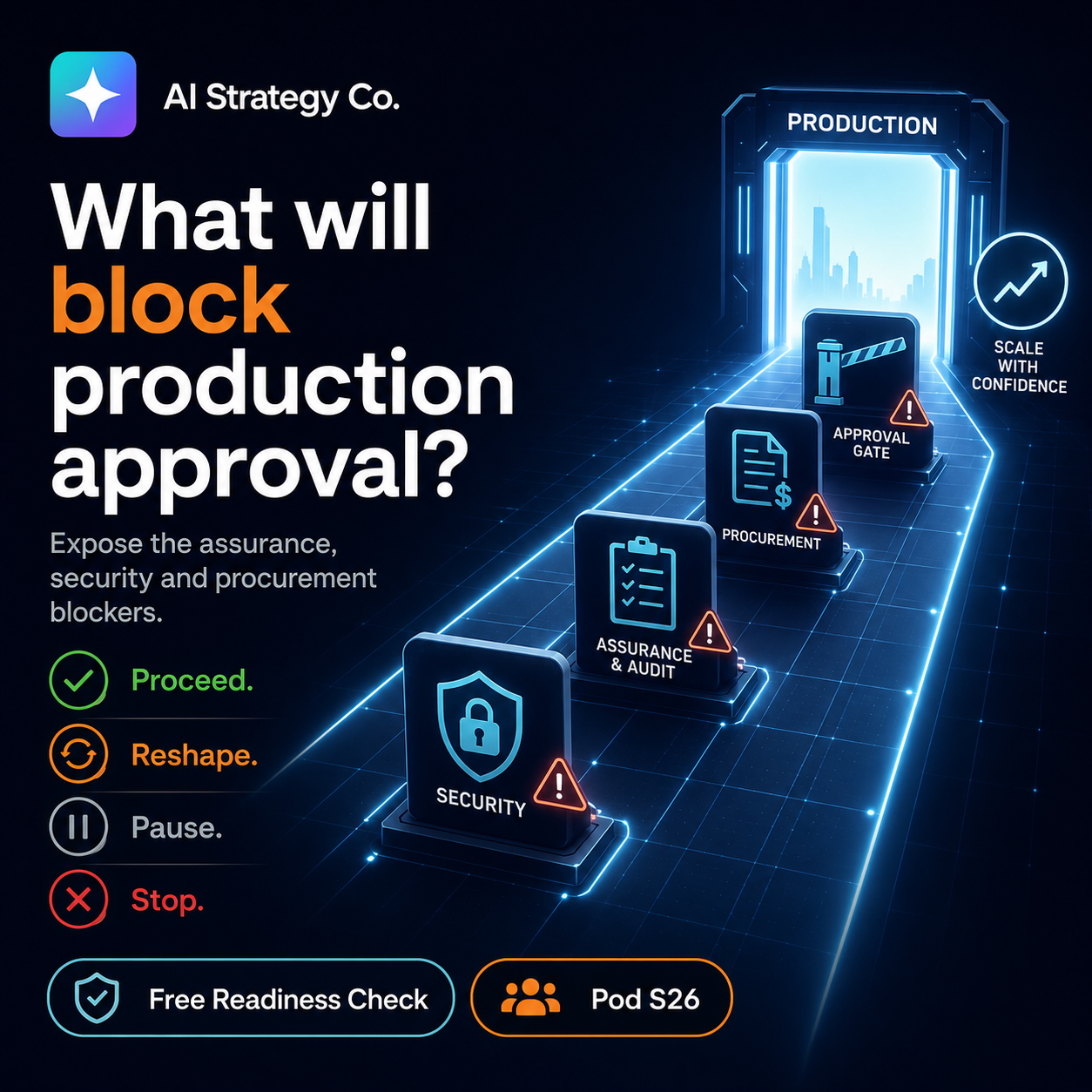
Surface the security, assurance, privacy, records and procurement evidence required before production.
The discussion stays focused on the smallest set of questions that can improve the next production, procurement or approval decision.
Who owns the AI-enabled workflow, its outcomes and the final decision to move forward?
What data can the AI access, generate, retain, disclose or send to a third party?
Where does human judgement remain mandatory, and who can approve, override or reject an output?
What happens when confidence is low, the AI is wrong, the request is sensitive or the workflow fails?
What will cyber, privacy, records, risk, audit, legal and procurement need to see?
Which models, platforms, integrations and vendor claims affect production readiness?
How will logging, traceability, monitoring, continuity, access and usage controls work in practice?
Which next route best fits the pilot: Proceed, Reshape, Pause, Stop or deeper structured work?
The strongest conversations start with a specific workflow, pilot, procurement decision or approval blocker.
The page keeps advisory, governance, solution design and implementation responsibilities clearly separated.
Where the free check identifies a material blocker, a separately scoped engagement can produce a decision-ready pack for one government AI workflow.
Previews are deliberately simplified to demonstrate the output while protecting the underlying method, mappings and reusable control IP.
Shows where the AI sits, who owns each handoff, where human review occurs and what triggers escalation.
Shows what the AI can access, retain, expose or trigger across agency, platform and vendor boundaries.
Consolidates the decision view, priority gaps, accountable owners and next actions for the pilot.
AI Strategy Co. provides an independent, buyer-side view of the workflow and decision path across platform-native, third-party and hybrid AI options.
Start with the government workflow, operating need and decision constraints.
Separate vendor claims from the evidence required for a defensible production decision.
Use the smallest useful advisory step that can move the decision forward.
Complete the short form, then choose an available 20-minute session in Calendly. Your pilot details are saved before the scheduling window opens.
The free check is a preliminary triage conversation. Any deeper advisory, governance or solution work is scoped separately.
A one- or two-sentence description of the AI pilot, workflow or candidate use case is enough. Supporting material is optional.
The free check is a preliminary triage conversation. Formal approval, audit, control mapping, DDQs and evidence-pack work are scoped separately where required.
The free check provides a decision view, priority gaps and recommended route. The AI Workflow Control Pack is a paid decision asset delivered through deeper structured work.
Yes. The most useful combination is usually the business or project owner together with a technical, cyber, privacy, risk, procurement or service-delivery representative.
Yes. Calendly will show the available event and post-event appointment times.
Leave knowing whether it should Proceed, Reshape, Pause or Stop — and what must be resolved before production.